What is a feature spec? How to write one, with an example and template
A feature spec describes the problem, intended behavior, scope, and acceptance criteria for a software feature before it's built.
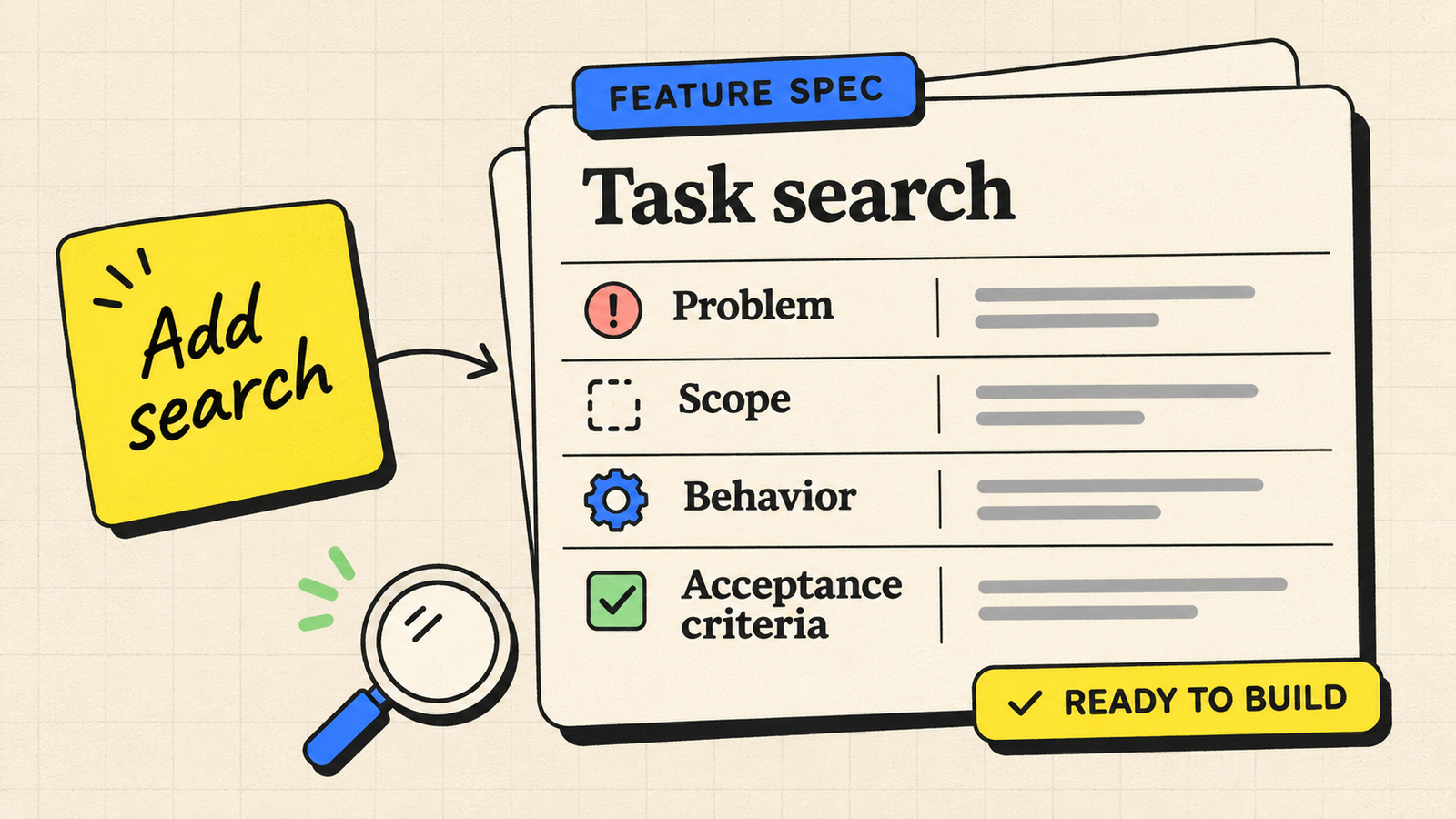
A feature spec describes the problem a software feature solves, the behavior it should support, its scope, and how the team will check the result. It might be a short document or a bundle of related planning materials, depending on the feature.
In a business that depends on custom software, the person who understands the workflow may also be the person with the least time to explain it. Developers and contractors need that context before they can improve an internal tool or replace software the business has outgrown. A clear feature spec keeps the agreed decisions together, so the team spends less time chasing answers and rebuilding the wrong thing.
What goes in a feature spec?
A feature spec answers six questions:
- Who has the problem, and what happens today?
- Why should the team build this now?
- What should happen when a person or another system uses the feature, including when something fails?
- What is in the first release, and what is left out?
- Which observable checks show that the feature works?
- What is still undecided, and who owns each decision?
Feature spec template
Copy these sections into your planning tool. A small feature needs a line or two per section.
- Feature and status: The change, the decision owner, and whether it's a proposal or approved.
- Problem: Who has the problem, what happens today, their workaround, and the evidence.
- Priority: Why this matters now, its priority, and which objective it supports.
- Outcome: The intended result and how the team will check whether it was achieved.
- Behavior: The main flow, plus relevant empty, loading, error, and permission states.
- Scope and non-goals: What's in the first release, what's deliberately out, and dependencies.
- Designs and constraints: Linked designs, product rules, technical context, and accessibility needs.
- User stories and acceptance criteria: Each capability, with pass/fail checks someone can observe.
- Open questions: Each unresolved decision, its owner, and whether it blocks the build.
How to write a feature spec
1. Describe the problem
Start by writing down who has the problem, what they experience, and how they handle it today. Product teams often call this an idea brief. Write it before agreeing to the solution a customer suggests, because the request and the need can differ.
At Lemongrove, a beta partner once asked to attach an Excel spreadsheet while planning a feature. The request started an hour-long team discussion and several follow-up conversations, because nobody could tell what the partner actually needed. The answer also decided whether the request fit Lemongrove at all.
Here is how that request looks before and after it becomes the start of a spec.
Before, the request as it arrived:
- "We need to upload Excel files."
After, the first lines of a spec:
- Problem: A partner has data in a spreadsheet that a feature they're planning will use.
- Open question: Does the team need the data's structure documented, so engineers can build for it? Owner: product. Blocks the build: yes.
- Open question: Does the data itself need to load into the feature at launch? Owner: product. Blocks the build: yes.
The questions show that "upload Excel files" could mean two different features, and each one needs a different build.
Questions about past behavior get more reliable answers than questions about the future. Rob Fitzpatrick's book The Mom Test explains why: people are poor at predicting what they'll do. Ask these:
- When did this last happen, and what were you trying to do?
- What did you do about it?
- How often does it come up, and what does it cost you?
Note where the problem came from, such as a customer call, a support ticket, or usage data. One customer asking for something is a signal worth checking against others.
2. Explain why it matters now
Write a sentence or two on why this problem should win over the rest of the backlog. An objective-based roadmap makes the call easier. If a request doesn't support the current objective, you can tell the customer, "We hear you. Our focus this cycle is X." Without that anchor, priorities tend to follow the loudest voice, whether that's a large customer, sales, or customer success.
If the evidence is thin, a customer conversation or a quick prototype may be a better next step than a build.
3. Describe how the feature behaves
Walk through what should happen and how the product or connected systems should respond. This part is sometimes called the solution brief. Cover the main flow first, then relevant edge cases such as errors, empty results, slow responses, and permission limits. Describe the intended behavior and constraints; the developer or coding agent works out the implementation against the codebase.
4. Set the scope and non-goals
Decide what the first release includes, and list the non-goals: things a reasonable person might expect that you're deliberately leaving out. You only need to list what people are likely to assume. If the work is large, split it into releases that each stand on their own.
5. Write user stories and acceptance criteria
A user story describes a capability from the user's point of view, usually in the form "As a [user], I want [action] so that [benefit]." Acceptance criteria are the specific checks that show the story works. The example below shows both.
6. Close the open questions
Review the spec with whoever owns product, design, and engineering before building starts. Give each open question an owner and mark whether it blocks the build. AI can help find gaps. Try a prompt like: "Review this feature spec for missing decisions and conflicting requirements. Keep confirmed requirements separate from suggestions, and ask me questions about anything unclear." A person on the team should still approve every change to the spec.
Feature spec example: task search
This example is hypothetical. A team gets a request to "add search" to a project management app.
- Problem: Project members who remember part of a task title have to click through several pages to find it.
- Outcome: In usability tests, 9 out of 10 members find a known task in under 10 seconds. The team will compare that with the time it takes to browse today.
- Behavior: A search field above the task list matches any part of a task title, ignoring capitalization, across every page of the current project. Results keep the current sort order. Clearing the search restores the full list.
- Edge cases: A failed request shows an error with a retry button. A search with no matches shows a "no results" message. If two searches overlap, the newest one controls the results.
- Non-goals: Searching descriptions or comments, searching across projects, typo tolerance, and saved searches.
- Constraints: Results respect existing project permissions. Hidden tasks never appear in results or in the result count.
- User story: As a project member, I want to search task titles in my current project so I can find a task without clicking through every page.
- Open question: What response time is acceptable for projects with thousands of tasks? Owner: engineering lead. Resolve during build planning, before implementation starts.
Acceptance criteria examples
Acceptance criteria turn a user story into checks a reviewer can pass or fail. Atlassian's guide to acceptance criteria stresses keeping them clear and concise enough for everyone on the team to understand. Teams usually write them in one of two formats.
Given/When/Then format, a scenario style described in the Agile Alliance glossary:
- Given a task titled "Send invoice" on page three of the current project, when a member searches for "INVOICE," then that task appears in the results.
- Given a member without access to a task, when they search for its title, then the task does not appear and the result count excludes it.
- Given a search with no matches, when the results load, then the page shows a "no results" message and a way to clear the search.
Checklist format:
- A task with "invoice" only in its description does not appear.
- A failed search keeps the query and offers a retry.
- The search field has an accessible label and works with a keyboard.
- Screen readers announce the result count without moving focus, following the W3C guidance on status messages.
Good criteria describe something a user or reviewer can see. "Search should feel intuitive" can't be tested. "A user can clear the search when there are no results" can.
Feature spec vs. PRD vs. user story
- PRD: A broader initiative: the goals, business context, and several features. Typical length: Several pages
- Feature spec: One feature: problem, behavior, scope, and acceptance criteria. Typical length: As much detail as needed, in one document or a bundle
- User story: One capability from the user's point of view. Typical length: One sentence, plus criteria
Checklist: is your feature spec ready for build planning?
Before creating the build plan, check that the spec covers each of these:
- The problem names who has it and cites at least one piece of evidence.
- The team understands the feature's priority and dependencies.
- The intended outcome is clear, with a way to measure it where appropriate.
- The main flow and relevant error, empty, loading, and permission states are described.
- Non-goals are listed.
- Every user story has acceptance criteria a reviewer can pass or fail.
- Every open question has an owner, and decisions that block build planning are resolved.
- Product, design, and engineering have reviewed it.
How Lemongrove helps you write feature specs
Lemongrove is an AI planning tool that turns ideas into clear feature plans and requirements. Its process follows the steps above. A feature starts with an idea brief covering the problem and who feels it, then a solution brief describing the intended behavior, with a place for designs. Lemongrove then develops release bands and user stories, and asks follow-up questions to fill gaps.
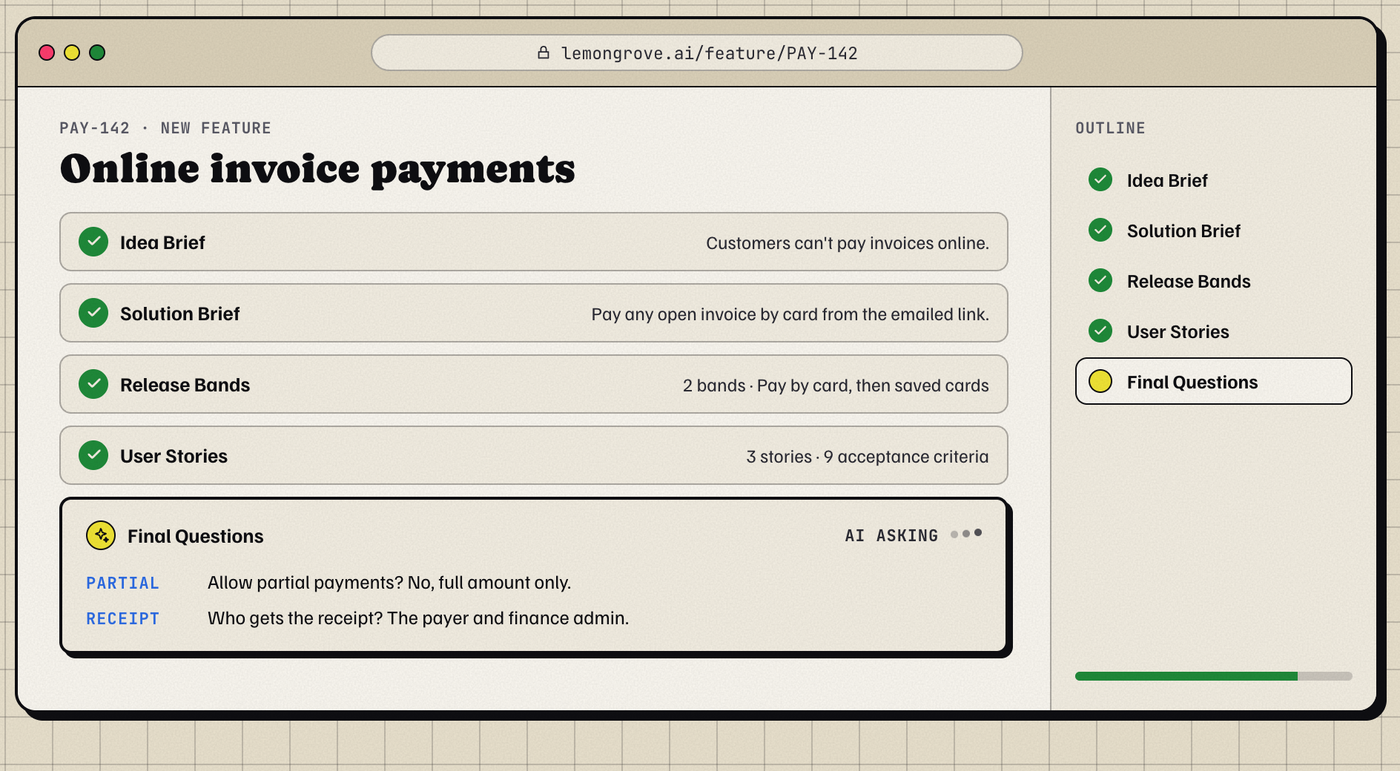
A feature plan in Lemongrove, from idea brief to final questions. Source: lemongrove.ai.
Features sit in a shared backlog, so the team can compare and prioritize them in one place. The feature spec is packaged into a bundle containing the problem, intended behavior, scope, user stories, and acceptance criteria. The developer or coding agent then examines the codebase and creates a build plan. That step can surface dependencies or questions that need to go back to the product team. The coding harness supplies the instructions, context, tools, and checks that guide the agent through planning, implementation, and review; it is separate from the feature spec.
To get started, pick one feature from your backlog and fill in the template above. Begin with the problem and the scope boundary most likely to be misunderstood.
Join the Lemongrove waitlist to plan an internal tool, replace software you’ve outgrown, or coordinate your next software improvement.
About the author
Brandon Nolte is Head of Growth at Lemongrove. He bootstrapped a company to over $12 million in total sales before exiting. He now builds software with AI. Connect with him on LinkedIn.
Frequently asked questions
How long should a feature spec be?
Long enough for the team to agree on behavior, scope, and how the feature will be checked. A small change can fit on one page. Features that involve permissions, sensitive data, or dependencies on other work usually need more detail.
Who writes the feature spec at a small company?
The person who understands the business problem should help define it with the person responsible for the solution. That might be an operations lead, department owner, founder, or product manager. They can start with the idea brief and hand it to a product or solution owner to develop further. A developer or coding agent then grounds the feature spec in the codebase before implementation.
Is a feature spec the same as a technical spec?
No. A feature spec describes the problem, intended behavior, scope, and acceptance criteria. A technical spec or build plan describes how to implement that behavior in a particular codebase, including technical decisions and dependencies. A developer or coding agent creates that plan by examining the codebase and reviewing the feature spec. This can reveal questions that require the feature spec to be refined.
Can AI write a feature spec?
AI can organize notes, challenge assumptions, surface edge cases, and draft user stories and acceptance criteria. Someone with the right business or product context still needs to confirm the problem and approve the intended behavior and scope. Keep AI suggestions separate from confirmed requirements until they have been reviewed.